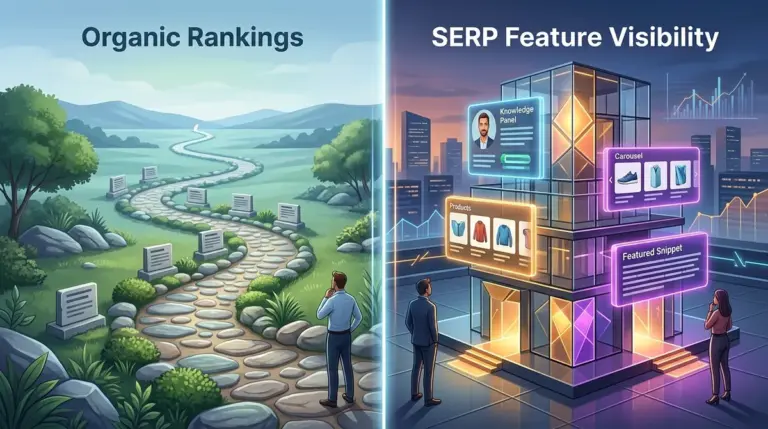
In the early days of search engine optimization, the math was simple: ranking in position one meant capturing roughly 30% of the available traffic for a given keyword. Today, that math is broken. A standard organic listing in the top spot can now be pushed so far down the page by ads, AI-generated summaries, and rich snippets that it effectively sits "below the fold" on mobile devices. For SEO professionals and stakeholders, focusing solely on numerical rank is a vanity exercise that ignores the reality of visual real estate and click-through rate (CTR) degradation.
The Geometry of the Modern SERP
Search engine result pages (SERPs) are no longer a linear list of ten blue links. They are a complex grid of interactive elements designed to satisfy user intent without requiring a click. When you rank in position one for a high-intent commercial query, you are often competing with four top-of-page sponsored ads, a Local Pack (the "Map Pack"), and potentially a Featured Snippet. In these scenarios, the first organic result might not appear until the user has scrolled 1,500 pixels down the page. This shift means we need to understand how AI overviews are changing SERPs and their impact on organic visibility.
Key Metric: Pixel Depth. This measures the actual distance from the top of the browser window to the start of your listing. A position one result with a pixel depth of 2,000 is objectively less valuable than a position three result with a pixel depth of 600.
The Rise of Zero-Click Searches
The primary driver of the "invisible #1" phenomenon is the zero-click search. Google’s goal is increasingly to provide the answer directly on the results page. Featured Snippets, Knowledge Panels, and "People Also Ask" (PAA) boxes are designed to extract the most relevant data from your page and display it so the user never has to visit your site. While you technically hold the top spot, your traffic may plummet because the user’s curiosity was satisfied by the preview text alone.
Warning: Monitoring rank without monitoring SERP features is a blind spot. If a keyword moves from position three to position one but a new AI Overview (SGE) appears above it, your actual traffic will likely decrease despite the "improvement" in ranking.
Visual Competitors That Outshine Organic Links
Even when an organic link is visible, it is often outcompeted by more visually aggressive elements. Searchers are conditioned to look for visual cues rather than reading text. The following elements frequently draw more attention than a standard position one link:
- Local Packs: For any query with local intent (e.g., "HVAC repair near me"), the map and the three-business list occupy the most prominent screen space.
- Image and Video Carousels: For "how-to" or product-based queries, visual carousels break the vertical flow of the page, drawing the eye away from text-heavy organic results.
- Sponsored Shopping Tiles: In e-commerce, the top row of product images with prices and ratings effectively acts as the true "position one" through "position five."
- AI Overviews (SGE): These generative responses can occupy the entire first screen on mobile, pushing even the most optimized organic content into a secondary scroll.
The Impact of Search Generative Experience (SGE)
The introduction of AI-driven summaries has fundamentally changed the value of the top spot. SGE synthesizes information from multiple sources to provide a comprehensive answer. While these summaries often cite their sources, the links are frequently tucked into a carousel or a drop-down menu. If your content is used to train or inform an AI summary, you may technically be the "source" for the top result, but the click-through potential is a fraction of what a traditional organic link would yield.
Agencies must now report on "Attributed Visibility" rather than just rank. This involves analyzing whether your brand is mentioned within the AI summary or Featured Snippet, even if the traditional blue link is pushed further down.
Shift Your Strategy to Share of Voice
To accurately measure success in a fragmented SERP environment, marketers must move away from rank tracking as a standalone KPI. Instead, focus on Share of Voice (SoV). This metric calculates your brand's visibility across all SERP elements, including ads, snippets, and PAA boxes, weighted by the click-through probability of each element.
Best for: Large-scale e-commerce and publishers who need to justify SEO spend against fluctuating traffic patterns that don't align with rank changes.
Optimizing for "Position Zero" and Beyond
If being in position one isn't enough, the goal must shift to occupying as many SERP "pixels" as possible. This is known as SERP Crowding. By optimizing for multiple features, you can dominate the visual space even if the organic link is displaced. This includes:
- Implementing Schema Markup to trigger Review Stars and FAQ dropdowns, which increase the vertical height of your listing.
- Optimizing images with descriptive alt-text and high-resolution files to appear in Image Carousels.
- Structuring content with clear H2 and H3 tags to increase the likelihood of winning a Featured Snippet.
Recalibrating Reporting for Stakeholders
When presenting data to clients or executives, the narrative must change. A drop in traffic despite stable rankings usually indicates a change in the SERP layout, not a failure of the SEO strategy. Use heatmaps or SERP screenshots to demonstrate how a new competitor ad block or an AI overview has altered the landscape. Explain that the goal is no longer just "ranking first," but "maximizing visibility."
Focus on "Weighted CTR" models. If a keyword has a high volume but the SERP is crowded with four ads and a map pack, the expected CTR for position one might only be 5% instead of the traditional 30%. Adjusting expectations based on SERP volatility is essential for realistic forecasting.
Actionable Steps for Visibility Dominance
Stop chasing the number one spot in a vacuum. Instead, audit your high-value keywords for their visual composition. If a keyword's SERP is dominated by videos, your strategy should shift toward YouTube optimization rather than just on-page text. If the SERP is heavy on PAA boxes, focus on long-tail question-based content. The objective is to appear where the user's eye actually lands, which is increasingly detached from the traditional organic list.
Monitor your "Above the Fold" presence weekly. If your primary conversion-driving keywords are no longer visible without a scroll, it is time to reconsider your bidding strategy in Search Ads or your investment in rich media content. Visibility is a zero-sum game of screen real estate, and the rules of the game are dictated by the layout, not just the algorithm.
Frequently Asked Questions
Why did my traffic drop even though my rank stayed at #1?
This is usually caused by a change in the SERP layout. Google may have introduced a new AI Overview, an additional ad slot, or a Featured Snippet that pushes your organic link further down the page, reducing its visual prominence and CTR.
What is the difference between rank and visibility?
Rank is your numerical position in the organic list. Visibility is a measure of how much screen real estate your brand occupies across all features, including ads, snippets, and maps. Visibility is a more accurate predictor of traffic in the modern search environment.
How can I improve visibility if I am already in position one?
Focus on "expanding" your listing. Use Schema markup to add FAQ or Review snippets, which increases the physical size of your link. Additionally, try to win the Featured Snippet or appear in the "People Also Ask" section to occupy multiple spots on the same page.
Is it still worth targeting position one for high-competition keywords?
Yes, but you must evaluate the SERP first. If the top of the page is entirely covered by ads and AI summaries, the ROI of ranking #1 organically may be lower than targeting a long-tail keyword with a "cleaner" SERP where the organic link is more visible.