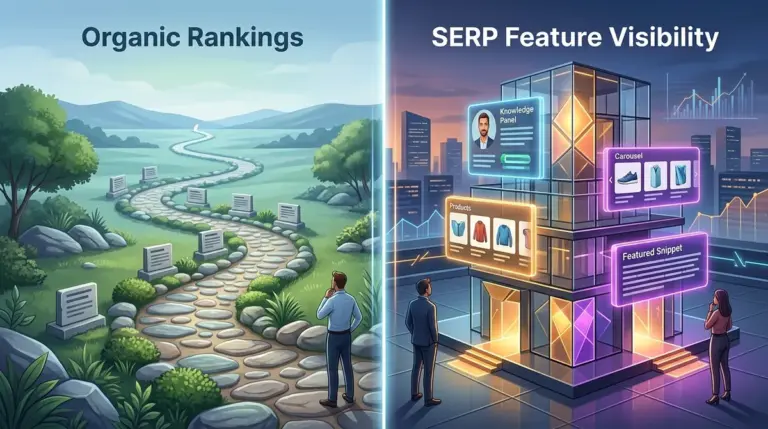
The traditional concept of "Position 1" has undergone a fundamental shift. For years, SEO success was a linear pursuit of the top blue link. With the integration of AI Overviews (AIO) into standard search results, that top spot is frequently pushed 1,000 pixels down the page, buried beneath a generative summary that synthesizes information from multiple sources. For agencies and in-house teams, this means tracking software that only reports numerical rankings is now providing an incomplete—and potentially misleading—picture of organic visibility. This shift highlights why the top spot isn't always visible to users, impacting how we measure organic success.
The Displacement of Organic Real Estate
AI Overviews do not simply sit on top of organic results; they restructure the entire visual hierarchy of the SERP. When an AIO triggers, it occupies significant vertical space, often forcing the first organic result below the fold on mobile and desktop alike. Tracking tools must now account for "pixel depth" rather than just rank order. If your keyword ranks at position two, but an AI Overview with three expanded citations sits above it, your click-through rate (CTR) will not align with historical benchmarks for that position.
Critical Metric: Share of Voice (SoV) must now be calculated by including citation presence within the AI block. If your brand is cited as a source within the generative text, you are effectively "ranking" in a zero-position that carries more authority than the links below it.
Distinguishing Between Citations and Traditional Links
Tracking AI Overviews requires a distinction between being a "link in the list" and a "source for the synthesis." Google’s AI Overviews often pull data from high-authority domains that may not even appear on the first page of traditional results. This creates a dual-track tracking requirement:
- Primary Citation Tracking: Identifying if your URL appears in the carousel or the "show more" expansion of the AI response.
- Attribution Analysis: Monitoring which specific snippets of your content are being used to feed the LLM’s response.
- Volatility Monitoring: AIOs are more dynamic than standard rankings; they can appear, disappear, or change sources based on real-time data refreshes.
Warning: Do not rely on Global Rank averages. AI Overviews are highly sensitive to user intent and location. A keyword may trigger an AIO for a "How-to" query but revert to standard blue links for a "Best [Product]" query. Your tracking must segment by intent to avoid data skewing.
The Impact of the 'Generate' Button on Data Accuracy
A significant challenge in modern position tracking is the "opt-in" nature of some AI responses. In many instances, Google presents a "Generate" button rather than an immediate AI Overview. Standard automated scrapers may not trigger this button, leading to a discrepancy between what a tracking tool sees and what a logged-in user experiences. To maintain accuracy, tracking protocols must now simulate user interaction or utilize headless browsers that can render the full generative state of the page.
Best for: Enterprise SEOs managing high-intent informational keywords where the "Generate" button frequently appears, as these queries are most at risk for traffic cannibalization.
Identifying High-Risk Keyword Clusters
Not all keywords are equally affected by AI Overviews. Commercial "buy" keywords currently see lower AIO penetration compared to informational "what is" or "how to" queries. To protect your reporting, you must categorize your keyword sets by their susceptibility to AI displacement. This allows you to explain traffic drops to stakeholders by pointing to SERP feature changes rather than a loss in content quality.
Informational Queries
These are the primary targets for AIO. Tracking here should focus on "Citation Share." If you are not in the AI box for an informational query, your traditional rank is largely irrelevant for top-of-funnel traffic.
Commercial and Transactional Queries
While less affected now, Google is increasingly testing AI-led product comparisons. Tracking tools need to monitor for "Product Carousels" embedded within AI responses, which function differently than standard Google Shopping results.
Adapting Reporting for Client Transparency
Reporting on "Position 3" is no longer sufficient when that position is visually buried. Modern SEO reports should include a "Visual Rank" metric. This metric calculates the actual visibility of a result based on its screen coordinates. If an AI Overview, a Sponsored block, and a People Also Ask (PAA) box all precede your result, a "Position 1" ranking is effectively "Position 4" in terms of user eye-tracking.
To provide commercial value, tracking must now bridge the gap between Search Console data—which may still report a high average position—and the reality of lower CTRs caused by AI-driven answer satisfaction. When users get their answer directly from the SERP, the "click" never happens, but the brand impression still carries value.
Prioritizing Your Tracking Roadmap
To stay ahead of AI-driven SERP changes, shift your tracking strategy toward these three pillars. First, audit your current keyword portfolio to identify which terms trigger an AI Overview. Second, measure the "Citation Gap"—the difference between where you rank in blue links versus your presence in AI summaries. Third, integrate pixel-height data into your performance dashboards to provide a more honest assessment of organic visibility. The goal is no longer just to be first; it is to be the source that the AI trusts most.
Frequently Asked Questions
Does a ranking in an AI Overview count as a position in Google Search Console?
Yes, Google generally counts a citation in an AI Overview as a position, but the way it is recorded can vary. If the AI Overview appears at the top, it may be logged as Position 1, even if it is a synthesized result rather than a direct link to your site.
How do I track if my site is being used as a source for AI Overviews?
You must use a rank tracking tool that specifically captures SERP features and provides HTML snapshots. By analyzing these snapshots, you can identify if your URL appears in the attribution cards or the expanded text links within the AI-generated response.
Will AI Overviews decrease my overall organic traffic?
For informational queries where the AI provides a complete answer, CTR typically decreases because the user's intent is satisfied on the SERP. However, for complex topics, being cited as a source can drive high-quality, high-intent traffic from users looking for deeper verification.
Should I stop targeting keywords that have an AI Overview?
No. Instead, you should optimize your content to become the cited source. If an AI Overview is present, it is the most prominent element on the page; failing to appear in it means losing the majority of the query's visibility to competitors who are cited.