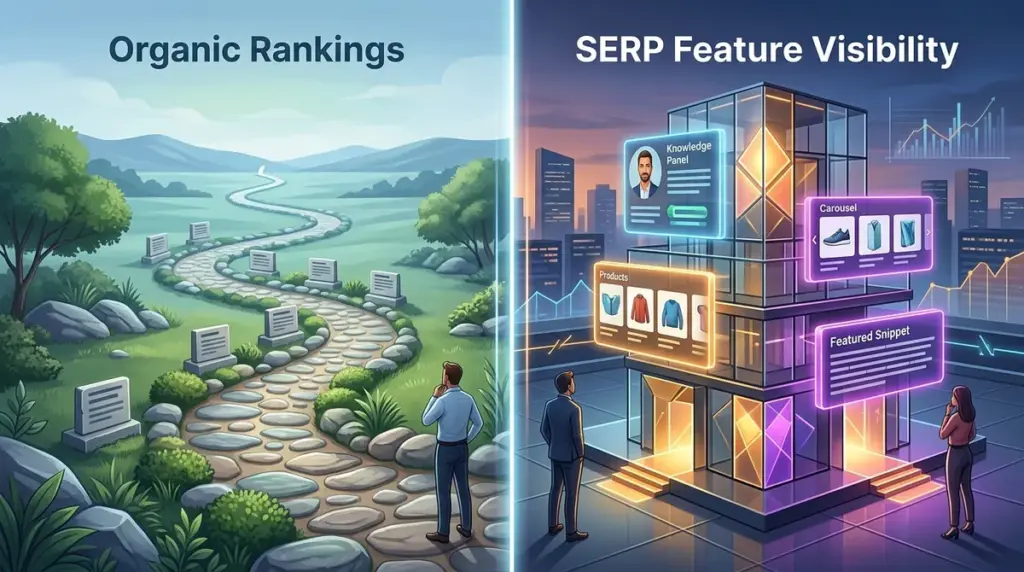
In the current search landscape, the traditional "blue link" organic ranking is no longer the sole arbiter of traffic. A site can hold the number one organic position for a high-volume keyword and still see a declining click-through rate (CTR) because a Featured Snippet, a Local Pack, or a four-pack of Google Ads has pushed that result below the fold. For SEO professionals and agencies, the decision is no longer just about climbing to the top of the list; it is about capturing the most valuable real estate on the Search Engine Results Page (SERP).
The Mechanics of Traditional Organic Rankings
Organic rankings refer to the non-paid listings that Google’s algorithm deems most relevant to a user's query. Historically, the goal was simple: reach position one. The value of these positions is tied to a predictable CTR decay curve. In a standard SERP without heavy features, the first position typically captures roughly 28% to 32% of clicks, with a sharp drop-off for positions four through ten.
Best for: Long-form educational content, deep-funnel research, and queries where users require multiple sources of information before making a decision.
The primary advantage of a high organic rank is stability. While SERP features like "People Also Ask" (PAA) boxes can fluctuate based on real-time user behavior, organic rankings tend to be more resilient to minor algorithmic shifts, provided the content depth and backlink profile remain strong. However, the "pixel height" of these rankings is shrinking. On mobile devices, a top organic result may require two full swipes to reach if Google triggers a "Things to Know" module or a sponsored carousel. This diminishing pixel height makes tracking visibility across different SERP features more critical than ever for understanding true reach.
The Rise of SERP Feature Visibility
SERP features are non-standard elements like Featured Snippets, Knowledge Panels, Image Packs, and Video Carousels. These elements are designed to provide immediate answers, often resulting in "zero-click searches" where the user finds the information they need without ever leaving the Google ecosystem. For a brand, visibility in these features serves a different purpose than a standard link.
Best for: Brand awareness, quick-answer queries, local intent, and high-intent product searches where visual confirmation is required.
Visibility in a Featured Snippet (often called "Position Zero") can bypass the standard ranking hierarchy. Even if your page ranks at position four organically, Google may pull a paragraph from your content to answer a direct question at the very top of the page. This provides a massive boost in authority and brand recognition, though it may paradoxically lower your site’s internal pageviews if the snippet answers the user's question completely.
Pro Tip: When tracking performance, do not aggregate organic rank and feature visibility into a single average. A "Rank 1" with a Featured Snippet above it performs differently than a "Rank 1" that is the Featured Snippet. Track "Pixel Depth" to understand how far down the page your brand actually appears.
Measuring Share of Voice vs. Numerical Rank
Relying on a single numerical rank is an outdated reporting method. Modern SEO requires measuring "Share of Voice" (SoV) or "SERP Occupancy." This involves calculating what percentage of the total SERP real estate your brand controls. If you hold the organic position one, a PAA expansion, and a result in the Image Pack, your actual influence on that keyword is far higher than a simple "1" would suggest.
To prioritize your strategy, consider these factors when choosing between chasing a higher organic rank or a specific SERP feature:
- Query Intent: Does the user want a quick fact (Feature) or a deep dive (Organic)?
- Keyword Volatility: Does the Featured Snippet change daily? If so, organic stability is a better long-term investment.
- Competitor Dominance: If a competitor owns the Knowledge Panel, you are unlikely to displace them; focus on winning the PAA boxes instead.
- Device Type: Mobile users prioritize features; desktop users are more likely to scroll through organic links.
The Impact of Zero-Click Searches
The tension between organic rank and features is most visible in the rise of zero-click searches. According to various industry datasets, over 50% of Google searches now end without a click to a non-Google property. This is particularly prevalent in "What is" or "How to" queries. In these instances, being the source of a Featured Snippet is a branding play rather than a traffic play.
For commercial queries, such as "best CRM for small business," the SERP is often crowded with "Top 10" lists and comparison tables. Here, visibility in the "People Also Ask" section is critical. Each time a user expands a PAA question, Google may generate new questions, effectively pushing organic results further down. If your content isn't structured to answer these specific sub-questions, your organic rank 1 might as well be rank 10 in terms of actual visibility. If your content isn't structured to answer these specific sub-questions, your organic rank 1 might as well be rank 10 in terms of actual visibility, making tracking People Also Ask rankings vital.
Strategic Integration: How to Balance Both
A sophisticated SEO strategy does not choose one over the other; it uses organic rankings as the foundation and SERP features as the accelerator. This requires technical execution in two areas: Schema Markup and Content Architecture.
By implementing FAQ, How-to, or Product schema, you provide Google with the structured data necessary to display your content as a rich result. This doesn't necessarily improve your organic "position," but it increases your "visual footprint." A result with star ratings, price points, and expandable FAQ toggles will always out-click a plain text link, even if the plain link is one position higher.
Actionable Reporting and Optimization Steps
To move beyond basic rank tracking, agencies and marketers should adopt a more granular approach to data analysis. Stop reporting on "Average Position" as a primary KPI and start segmenting data by SERP landscape.
First, audit your high-volume keywords to see which ones are dominated by features. If a keyword has a Local Pack and a Featured Snippet, your organic rank 2 is likely getting less than 5% of the clicks. In this scenario, you must optimize for the snippet or the local map to regain lost traffic. Second, use "True Rank" metrics—this calculates your position relative to all elements on the page, including ads and features, rather than just other organic links.
Finally, monitor the "SERP layout" changes. Google frequently tests new modules. A sudden drop in traffic despite stable rankings usually indicates that a new SERP feature has been introduced above your result. Identifying these shifts early allows you to adjust your content structure—perhaps by adding a concise summary for a snippet or better imagery for a visual grid—before the traffic loss becomes significant.
Frequently Asked Questions
Does winning a Featured Snippet hurt my organic CTR?
It depends on the query. For "definition" queries, CTR often drops because the user gets the answer on the SERP. For "process" or "comparison" queries, the snippet often acts as a teaser, actually increasing the CTR to the source page.
Can I rank in a SERP feature if I am not on page one?
Generally, no. Google almost exclusively pulls Featured Snippets and other rich elements from the top 10 organic results. However, you can jump from position 9 to "Position Zero" if your content is better structured for the snippet than the result in position 1.
How do I track my visibility if I don't have a traditional rank?
Use tools that measure "Pixel Height" or "Share of Voice." These metrics quantify how much of the screen your brand occupies, which is a more accurate predictor of traffic than a numerical list position in a feature-heavy environment.