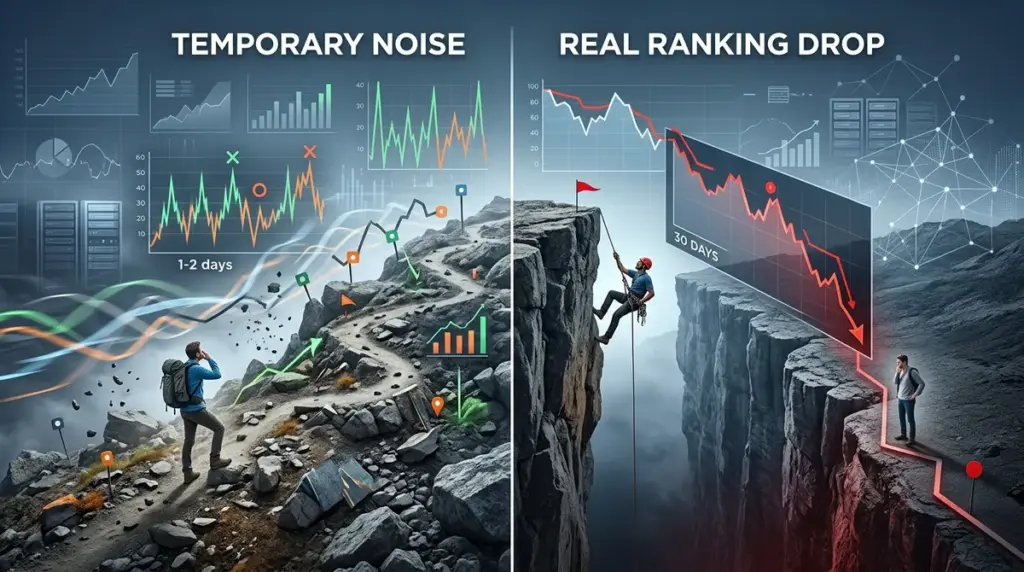
Panic is the most expensive reaction to a ranking drop. When a primary keyword slips from position three to position twelve overnight, the immediate impulse is to rewrite the metadata, overhaul the content, or aggressively build new backlinks. For an SEO agency or an in-house lead, these knee-jerk reactions often do more damage than the initial drop. If the movement was merely "Google dance" or temporary testing, changing the page resets the indexing process and can turn a 48-hour fluctuation into a permanent loss of equity.
Distinguishing between a meaningful algorithmic shift and standard SERP noise requires looking past single-day snapshots. Real drops are characterized by persistence, breadth across related clusters, and technical correlation. Noise is characterized by high volatility, rapid recovery, and isolated keyword movement that doesn't reflect the overall health of the URL.
The 72-Hour Rule and Data Granularity
Daily ranking data is prone to "flux" as Google tests different results for different user intents or locations. A single data point showing a drop is not an actionable insight; it is a signal to monitor. To identify a real drop, you must observe the position over a minimum of three to five days. If the keyword does not return to its baseline or continue to oscillate within a narrow band, the drop is likely substantive. To truly measure ranking trends over time, you must observe the position over a minimum of three to five days.
Look for these indicators of a permanent shift:
- Cluster Correlation: If one keyword drops, but five related long-tail variations remain stable, you are likely seeing a temporary SERP test. If the entire cluster drops in unison, Google has likely re-evaluated the page's relevance for that specific intent.
- Rolling Averages: Compare the current week’s average position against the previous 30 days. A 10% dip in the rolling average is a stronger indicator of a problem than a 50% dip on a Tuesday morning.
- Competitor Mirroring: If your top three competitors also dropped, Google is likely experimenting with a new SERP feature (like an AI Overview or a Local Pack) that has pushed all organic results down.
Analyzing SERP Feature Displacement
Sometimes your "ranking" hasn't actually changed in the traditional sense, but your visibility has. Modern SERPs are crowded with non-blue-link elements. A drop from position 1 to position 4 might simply mean Google inserted a "People Also Ask" block or a "Product Grid" above the organic results. In this scenario, your page still holds the top organic spot, but the pixel depth has increased.
You must check if the drop is a "true rank" loss or a "visual rank" loss. If you are still in the same organic position but your CTR has plummeted, the solution isn't content optimization—it's schema markup or competing for the new SERP feature that displaced you. Real noise often comes from Google testing these features. If a featured snippet disappears and then reappears two days later, that is noise. If it stays gone for a week, your content may have lost its "snippet-ready" status due to a competitor providing a more concise answer.
Technical Triggers vs. Algorithmic Re-evaluation
A real drop is often tied to a specific technical event or a broad core update. If the drop is sitewide and sudden, the first place to look is not the content, but the server logs and Search Console. A sudden spike in 404 errors or a "NoIndex" tag accidentally deployed during a site update will cause a real, immediate drop that will not recover on its own.
Warning: Never attempt to "fix" content during the middle of a confirmed Google Core Update. Google’s systems are in a state of flux during these periods, and the rankings you see on day three of an update may be entirely different by day fourteen. Modifying your site while the update is still rolling out makes it impossible to determine what actually caused your eventual position.
If the drop is gradual—a slow bleed over several months—this is rarely "noise." This indicates "content decay" or that competitors are consistently earning more backlinks and engagement. This requires a different strategy than the "wait and see" approach used for sudden volatility.
The Impact of Data Refresh Cycles
Search engines do not crawl the entire web at once. They use different refresh cycles for different tiers of content. If you have recently updated a page and see a ranking drop, it may be because Google has crawled the new version but hasn't yet fully integrated it into the index or recalculated its relationship to other pages. This is a common form of temporary noise. Before reverting the changes, check the "Last Crawled" date in Search Console. If the crawl happened within the last 48 hours, the volatility is likely a standard part of the re-indexing process.
A Triage Protocol for Ranking Shifts
When you spot a significant downward movement in your tracking dashboard, follow this sequence before taking any corrective action:
Step 1: Verify the Scope. Is the drop limited to one URL, one keyword, or the entire domain? Domain-wide drops suggest technical issues or site-level penalties. Single URL drops suggest content relevance issues or new competition.
Step 2: Check for Manual Actions. Visit the "Manual Actions" tab in Google Search Console. If there is a notice, the drop is real and requires immediate legal or technical remediation. If it is empty, you are dealing with algorithmic movement.
Step 3: Compare Mobile vs. Desktop. If rankings dropped on mobile but stayed stable on desktop, you likely have a Core Web Vitals issue or a mobile usability error. This is a real drop that requires technical fixes, not content rewrites.
Step 4: Monitor the Volatility Index. Use a third-party volatility sensor to see if the entire web is experiencing high movement. If the "weather" is hot for everyone, your specific drop is likely part of a broader update and may revert once the update settles.
Immediate Steps for Recovery
If the drop persists beyond five days and you have ruled out SERP feature changes and site-wide volatility, you must act. Start by analyzing the pages that replaced you. Did they add more original imagery? Is their page speed significantly faster? Do they cover a sub-topic you missed? Use these concrete differences to guide your updates. Avoid "thin" updates like changing a few adjectives or updating the "published date" without adding real value; Google’s systems are increasingly adept at ignoring low-effort attempts to signal freshness.
Frequently Asked Questions
How long should I wait before reacting to a ranking drop?
Wait at least 3 to 5 days. Most temporary fluctuations caused by data center synchronization or minor algorithm testing resolve within this window. Reacting sooner often leads to "over-optimization" which can confuse search crawlers. These temporary fluctuations are a common occurrence and understanding their causes can prevent unnecessary panic.
Can a drop in rankings be caused by a competitor’s actions?
Yes. If a competitor launches a significant PR campaign or gains high-authority backlinks, they can leapfrog your position. This is a "real" drop, but it isn't because your site got worse; it's because theirs got better. You must analyze their new backlink profile and content depth to compete.
Why do my rankings look different in different tracking tools?
Rankings vary based on the location of the IP address used for the crawl, the device type, and the specific data center queried. Real noise often appears as discrepancies between tools. Always rely on a single, consistent tracking source for your primary reporting to ensure you are comparing apples to apples.
Does a drop in rank always mean a drop in traffic?
Not necessarily. If you lose rankings for high-volume but low-intent keywords while maintaining positions for high-conversion "money" keywords, your revenue might stay stable despite a "scary" chart in your rank tracker. Always correlate ranking data with actual traffic and conversion data from your analytics platform.