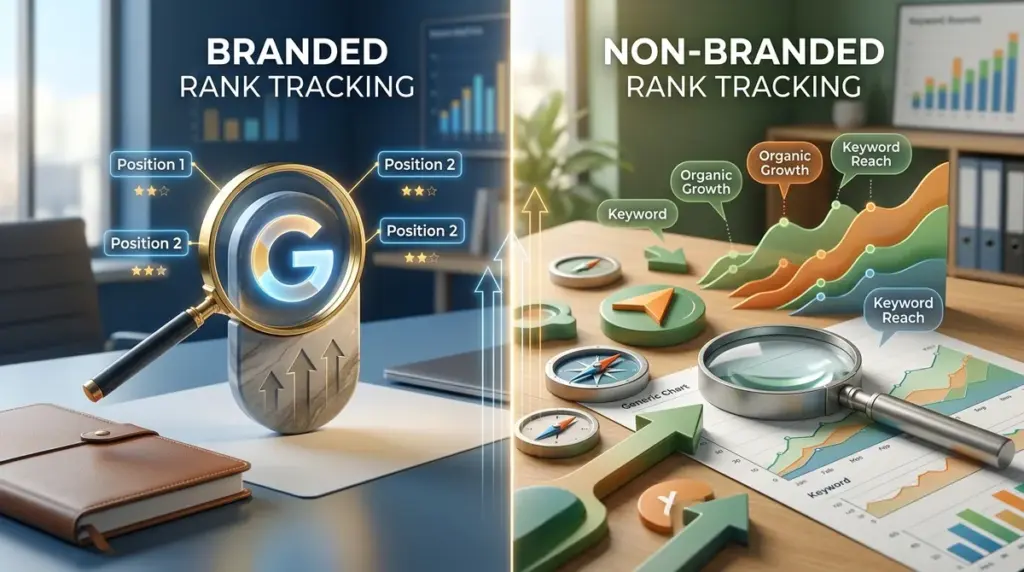
Tracking keyword rankings without separating branded and non-branded data is a fast way to misinterpret your SEO performance. Branded keywords act as a barometer for brand awareness and reputation, while non-branded keywords measure your ability to capture new market share from users who don't yet know your name. If you report an average position of 12 across your entire portfolio, you are likely masking a perfect score on your own name and a total failure to rank for high-intent industry terms. Effective rank tracking requires an immediate split between these two categories to ensure your strategy reflects commercial reality. To truly understand your SEO efforts, consider building a better position tracking dashboard that clearly separates these two vital metrics.
The Fundamental Value of Branded Rank Tracking
Branded keywords include your company name, specific product names, and variations or misspellings thereof. For most established businesses, these terms should consistently rank in position one. However, tracking them is not a vanity exercise; it is a defensive necessity.
Monitoring branded terms allows you to identify "brand hijacking." This occurs when competitors bid on your brand name in Google Ads or when third-party review sites, news outlets, or disgruntled former employees start outranking your secondary pages for specific brand queries. If your "Contact Us" or "Pricing" page drops below a third-party aggregator, you lose control over the customer journey and potentially pay a commission for a lead you should have owned for free.
Best for: Marketing directors and PR teams who need to monitor brand sentiment and ensure the SERP (Search Engine Results Page) displays the correct Sitelinks, Knowledge Panels, and official social media profiles.
Non-Branded Tracking: The Growth Engine
Non-branded keywords are the battleground. These are the "how-to," "best [product]," and "service in [location]" queries that drive new customer acquisition. Because these users are not looking for you specifically, the competition is significantly higher and the rankings are more volatile.
Tracking non-branded keywords provides a direct look at your Share of Voice (SoV) compared to competitors. If you are a SaaS provider for project management, tracking "task management software" tells you how you stack up against every other player in the industry. Fluctuations here directly correlate to changes in top-of-funnel traffic and organic revenue. Unlike branded terms, where you expect a flat line at position one, non-branded tracking is about incremental gains—moving from position 15 to position 4 can result in a 500% increase in click-through rate.
The Statistical Danger of Blended Metrics
The most common mistake in SEO reporting is presenting a "Global Average Position." This metric is almost always useless. Imagine a site tracking 500 keywords: 100 are branded terms where the site ranks #1, and 400 are non-branded terms where the site ranks #40. The average rank would be approximately #32. If the site loses 20 positions on every non-branded term but maintains the branded #1 spots, the average only shifts slightly, hiding a catastrophic loss of visibility.
By segmenting your data within Search Engine Position Tracker, you can see the health of each category independently. A drop in branded rank suggests a technical crawl issue or a manual penalty, while a drop in non-branded rank usually indicates a content quality issue, a competitor update, or a shift in Google's algorithm.
Warning: Competitors often use aggressive conquesting campaigns on your branded terms. If you aren't tracking your brand name daily, you may not notice when a competitor's ad or a "Top 10 Alternatives to [Your Brand]" listicle pushes your official site below the fold, effectively stealing your highest-converting traffic.
Segmentation Tactics for Professional Rank Tracking
To get the most out of your monitoring, you must go beyond a simple two-way split. Use tagging and filtering to create a granular hierarchy of data. This allows you to pivot your reporting based on who is viewing the data—executives want brand health, while SEO specialists want granular performance on "money" keywords.
- Brand Core: Your exact company name and primary URL.
- Brand Plus: Terms like "[Brand] reviews," "[Brand] pricing," or "[Brand] login."
- High-Intent Non-Branded: Keywords with "buy," "service," or "hire" modifiers.
- Informational Non-Branded: Blog topics, "how-to" guides, and industry definitions.
- Competitor Branded: Tracking your competitors' names to see if your comparison pages are gaining ground.
Reporting to Stakeholders with Precision
When presenting data to stakeholders, the narrative must change based on the keyword category. For branded terms, the KPI is Stability and SERP Real Estate. You want to show that you own the entire first page, including the "People Also Ask" boxes and image carousels. Any movement here is a red flag that requires immediate technical intervention.
For non-branded terms, the KPI is Velocity and Share of Voice. You should report on how many keywords moved from page two to page one, and how your visibility score compares to your top three market rivals. This is where you justify content budgets and backlink campaigns. Showing a 5% increase in non-branded visibility is a much more powerful indicator of SEO success than showing a 100% "perfect" score on branded terms that you already owned.
Establishing a Dual-Track Monitoring Workflow
To implement a professional tracking strategy, start by auditing your current keyword list. Identify every term that includes a brand identifier and tag it accordingly. Set up automated alerts for any branded term that drops out of the top three positions; this is usually a sign of a site-wide issue or a highly aggressive competitor move. For non-branded terms, set your reporting intervals to reflect your optimization cycle—weekly for high-competition terms and monthly for long-tail informational content.
By maintaining this separation, you ensure that your SEO data remains actionable. You stop celebrating easy wins on your own name and start focusing on the difficult, high-value non-branded terms that actually move the needle for business growth. This clarity allows for better resource allocation, as you can see exactly where your organic presence is vulnerable and where it is dominant.
Frequently Asked Questions
Should I track my competitors' branded keywords?
Yes. Tracking competitor brand names allows you to see if your "Alternative to [Competitor]" or comparison pages are ranking. It also helps you understand their search volume trends, which can serve as a proxy for their overall market growth or decline.
What is a healthy ratio of branded to non-branded traffic?
There is no universal ratio, but a healthy, growing site typically sees an increasing percentage of non-branded traffic over time. If 90% of your traffic is branded, you aren't doing SEO; you are simply harvesting existing brand awareness. Aim for a diverse mix that reflects both customer retention and new acquisition.
Why did my branded rank drop even though I haven't changed the site?
Branded drops are often caused by "SERP crowding." Google may be testing new features like AI Overviews, highly relevant news stories, or social media feeds that push your organic listing down. Alternatively, a competitor may have released a highly optimized comparison page that Google deems more useful for users searching for your brand's "pros and cons."